Ivan Kupala: rites and night magic
Filaniya · 13 min read
According to the church calendar. The feast marks the Nativity of John the Baptist. John's father Zachariah, high priest of the Temple of Jerusalem, lived with his wife Elizabeth in the mountains of Judea. And once, as Zachariah was holding service in the Temple, the Archangel Gabriel appeared to him, as tradition tells: "Thy prayer is heard, and thy wife Elizabeth shall bear thee a son, and thou shalt call him John. He shall be great before the Lord and filled with the Holy Spirit even from his mother's womb."
Zachariah would not believe the messenger, and as punishment lost the gift of speech. The priest spoke again only after his son John was born.
Tradition holds that the grown John became the nearest forerunner of Jesus Christ. In his mature years he withdrew into the Judean desert. Legend says he chose baptism — washing in water by immersion — as the outward law of repentance and spiritual deliverance. Christ Himself received baptism from John.
According to the folk calendar. Kupala is the most ancient feast blessing the sun, the ripeness of summer and the green haymaking. People girded themselves with bands of flowers and placed wreaths of herbs upon their heads. They danced in circles and sang songs. The elders kindled "living fire" by rubbing dry sticks, lit bonfires, and set in their midst a pole topped with a burning wheel — the symbol of the sun. The night of July 6th–7th is one of the most magical nights of all. On this night, the energies of the whole year are laid down.
The feast of Ivan Kupala — Kupala night — is preceded by the day of Agafia the Bathing Woman, observed on July 6th and dedicated to the memory of the holy martyr Agrippina (Agrafena in the Russian tradition). This day is usually understood as the opening stage of Kupala night and is considered a women's holiday. At this time, women and girls made ritual rounds of the fields and held ceremonial feasts upon them.
On this day the element of Water reveals itself in full force. On Agrafena the Bather, the sun itself bathes. Agrafena's day opened the swimming season and began the haymaking and herb gathering. People started binding bath besoms and brooms. At this time any ritual with water is healing. It is good to run through the morning and evening dew, to steam with a fresh besom, to bathe in open waters. To be wet, to wash with water or dew on this day, means happiness for the whole year. The evening is a fine time for gatherings: candles may be lit and wishes made for the night. A girl should place under her pillow a plantain leaf picked at a crossroads and say:
"Thrice-traveller, fellow of the road, thou livest by the wayside and seest young and old — show me my betrothed."
Those who celebrate Ivan Kupala's day as a pagan feast mark it on the night of June 21st–22nd. It is not connected with the baptism of John the Baptist. It is the feast of the Sun, of the cult of fire, of the plant world and water. And also the day when Moon and Sun, Water and Fire converge — the feminine and masculine principles. Children conceived on Kupala night were believed to grow into the strongest and bravest.
Buy a besom in the morning of an odd-numbered day, without haggling, and leave it by the threshold until evening. At sunset on July 6th, sweep out the whole house and yard, gathering the rubbish and repeating from time to time:
"With the new broom, all my hexes, illnesses, misfortunes and ill luck shall depart. Amen."
Carry the rubbish beyond the yard and burn it together with the broom at the crossing of two roads. Into the same fire throw your worn old clothes, especially if you are ill, saying:
"As the smoke scatters on the wind, so may all my hexes, illnesses, misfortunes and ill luck disperse. Amen."
And do not forget to write on a sheet of paper the troubles weighing on you and everything you wish to be rid of, and burn it in this fire.
Separately, on another sheet of paper, write what you wish to bring into your life. Wearing a ritual shirt, burn this leaf in a different bonfire, kindled at another crossroads from dry branches, firewood, straw and dried herbs left unused through the year. When the fire blazes up, stand in a circle and, holding one another by the hands, say together:
"Power of the One Source of All Being! Goddess, mistress of the Moon, and God, lord of the Sun! Power of the Spirits of the Heights and the bright Stars! Bless this moment, this place, and us, one with you (speak your names). Illuminate the Heavens with your light, illuminate the Earth with your light!"
At that moment, release your hands, take out the leaves with your wishes and cast them into the fire, saying:
They leap over the fire at a run, toward the four corners of the world — a leap counts as fortunate if the flame never touches the leaper and no sparks fly — foretelling marriage or good luck. As they leap, they chant:
Separately, a circle is built for the working, and an altar of natural stones and candles is prepared and adorned, upon which ritual acts are performed and food and drink left for the spirits.
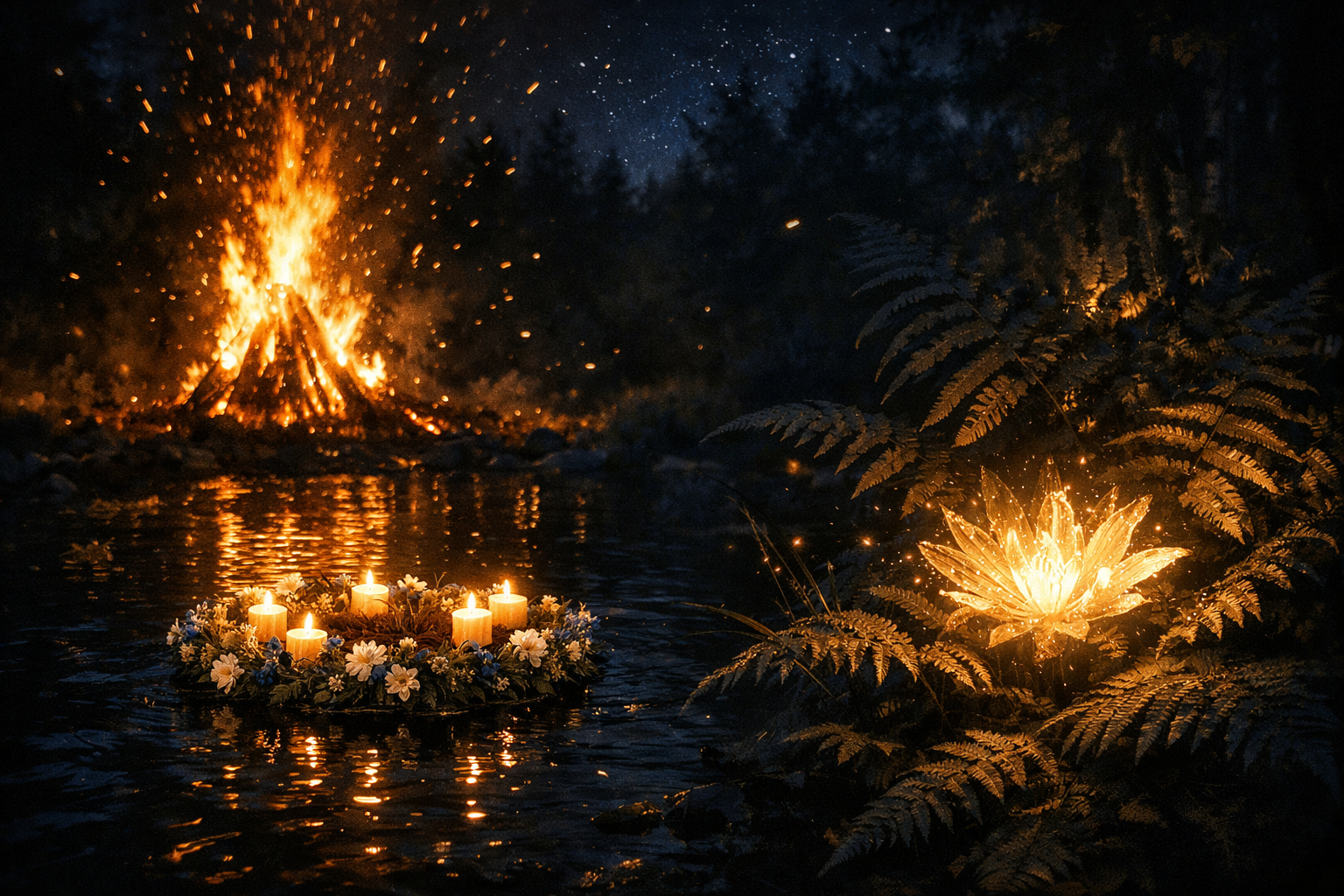
On Ivan Kupala, cast a wreath of birch and other herbs into the river: if it sinks — death; if it floats — marriage; if it drifts to shore — to remain unwed.
The distinctive marks of Ivan Kupala are the many customs and legends bound to the plant world. Herbs and flowers gathered on Ivan's day are dried and kept, revered as more healing than those gathered at any other time.
With them the sick are fumigated and evil spirits fought; they are thrown into the stoked stove during thunderstorms to guard the house from lightning; they are used to kindle love or for "drying off" a love spell.
On Ivan Kupala's day, girls twine wreaths of herbs: heartsease, burdock, wild thyme and mullein; in the evening they set these wreaths upon the water, watching how and where they drift. If a wreath sinks, her beloved has fallen out of love and she shall not marry him.
It was believed that on Kupala night the never-blooming fern bursts into flower, and that for whoever finds it, the fern will point the way to buried treasure all their life. The same power dwells in plakun-grass — loosestrife — said by legend to have grown from the Mother of God's tears. A special power, peasants believed, lies in its crown, which can drive away evil spirits; the owner of its root will inspire awe, laid beneath a house's threshold it admits no evil, carried upon one's person it shields from harm. It is gathered with these words:
"Plakun, plakun, thou hast wept much and wept little. Let not thy tears roll across the open field, let not thy wailing spread across the blue sea! Be terrible to evil demons and half-demons, to the old witches of Kyiv. They shall bow to thee — drown them in tears; should they flee thy dreaded gaze — lock them in the pits of hell. May my word be firm and fast with thee. Forever and ever. Amen!"
Other herbs are gathered with a prayer. Removing one's shoes, one says:
"Father-sky (raise hands upward), Mother-earth (hands downward)! Bless me to pick thy fruit (arms wide). Thy fruit serves every need: against sorrows, against sickness, and against all ailments of day and midday, of night and midnight."
St John's wort is plucked at exactly midnight and kept above the house's entrance against evil powers; chornobyl — mugwort — is hateful to witches and guards house and yard against them. It is braided into whips and laid beneath the Ivan dew with this sentence:
"Mother-earth, father-sky, grant Thy servants health from this herb!"
Zyablytsia herb helps against children's screaming and sleeplessness. Sore places on the body — cuts, boils, swellings — are dusted with the dried plant. Shepherd's purse has long been stored as a good remedy for bleeding of all kinds. Rheumatics gathered great quantities of stinging nettle. For wounds and burns, hare's cabbage — wood sorrel — was stocked. For colds and coughs, every home had to keep coltsfoot, oregano and wild rosemary.
The strongest amulets are the fern and the white water lily (odolen-grass, the "overpowering herb"), plucked on this day. The flower of Ivan-da-Marya — heartsease — is the emblem of this night.
At dawn, the tallest ear of grain is picked, saying:
"As this ear stands above all, so shall I, (name), stand above all. So let it be!"
Find an anthill and, tossing small coins into it, say:
"As the ants teem in this heap and never dwindle, so may money teem with me. Amen!"
Dew is also gathered with a tablecloth or towel into a vessel, and bathed in. Dew heals sickness; faces are washed with it for beauty; love spells are worked with it.
They charm themselves while bathing. Entering the water, sprinkling themselves, they read:
"The first matter is Ilya's, the second matter is Kupala's, the third matter is the church-porch matter, obedient to the Lord God. So may happiness submit to me, God's servant (name). Beneath the porch-tree, obedient to the Lord God, the grey fern grows. Beneath that grey fern, great happiness dwells. It grows, it rises, it clings to my body. Whoever knows Ivan's incantation and reads it nine times before Ivan's Day — to them, like this water, happiness and luck shall cling. My words I close, my deeds I seal. Key, lock, tongue. Amen. Amen. Amen."
At dawn, washing with dew and bowing to all four directions, say:
Holy Ivanyk, wash me with dew. Dew, thou water, be my sister. As dew dries in the foliage under the sun, so may all my misfortunes vanish; it is not I who speaks — Kupala spoke, washed me with dew and commanded all. To whomever God's servant (name) comes with a request, nowhere and never shall he meet refusal. In the name of the Father and the Son and the Holy Spirit. Amen. Amen. Amen."
Take a hunk of bread, salt it with Thursday salt — salt prepared on Maundy Thursday — and cast it against the current. Stand so that it floats toward you, and say: "Bread, honest salt, float where thou wilt, with the current, and bring me luck in return. In the name of the Father and the Son and the Holy Spirit. Amen."
On this day a husband's shirt is charmed so that he is kind and never beats his wife. For this, spread your husband's shirt upon the threshold and stand upon it with your feet, saying:
"Glory to God, peace to my threshold. Water quenches fire, and thou, (husband's name), shalt not touch me, God's servant (your name)! In the name of the Father and the Son and the Holy Spirit, now and ever and unto ages of ages. Amen."
Fern was picked and charmed on the night before Ivan Kupala:
As all know Ivan Kupala, as all the baptised revere him, so may all my words be known before the Lord, and from this very hour come true. God's servant (name), come, walk across the upper leaf. Remember me and love me always. Mayest thou pine for me, grieve, hold my image before thy bright eyes, speak of me with friends, yearn, suffer and dream of me. Everywhere and always, beneath sun and moon. Key, lock, tongue. Amen. Amen. Amen."
The fern is scattered where the beloved may pass.
Filaniya is now on Telegram
Open the bot