Autumn is wedding season: the magic of marriage
Filaniya · 27 min read
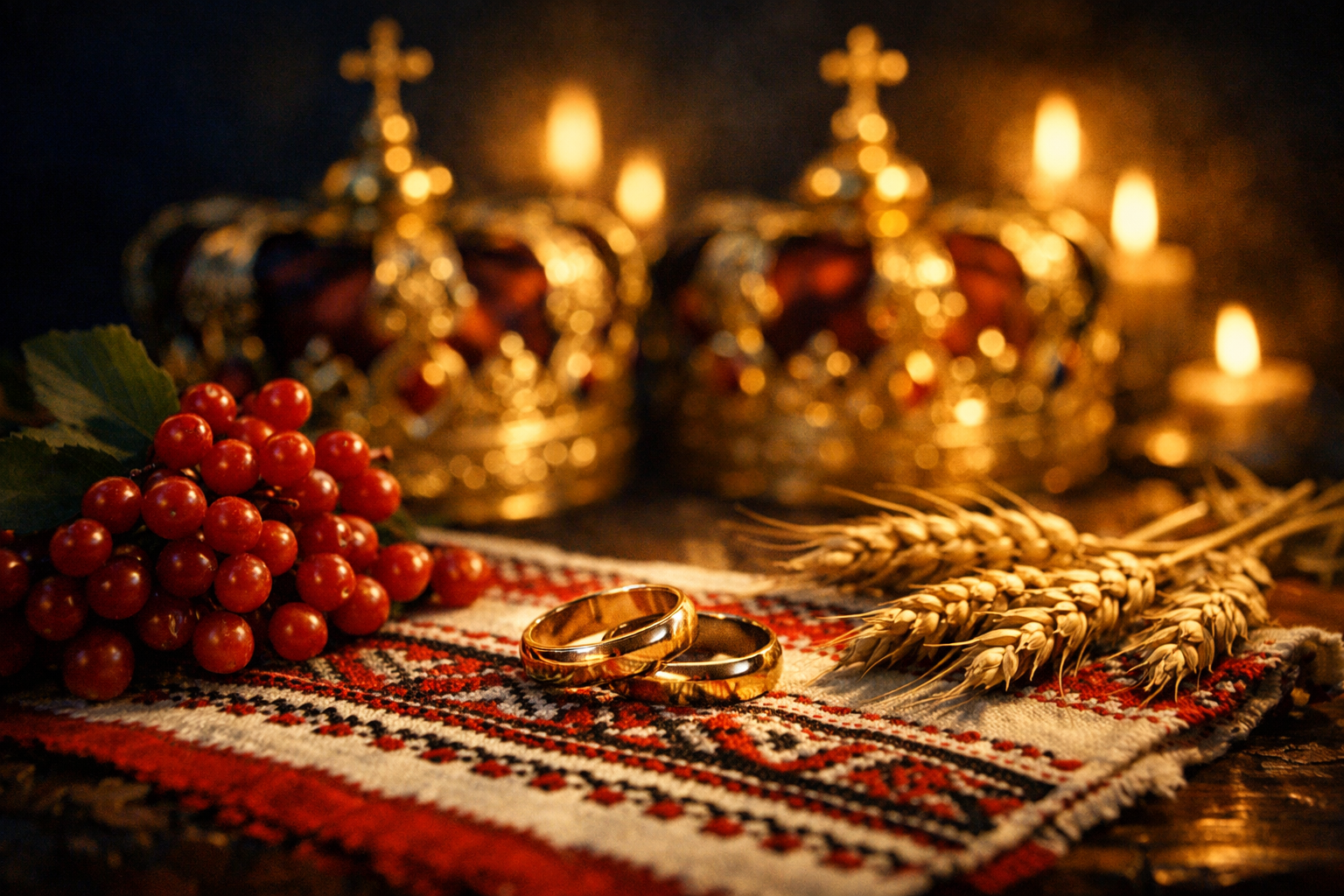
Folk customs and omens preserve a large part of the pagan heritage — healing traditions, sung and rhymed incantations, the use of herbs and potions, and of course wedding rituals. In Ukraine all of this is very visible and alive to this day, though not always understood by the ritual's own participants.
"The Ukrainian word "vesillia" (wedding) comes from the name of the solar feast "vselia", which was celebrated at every phase of the solstice with particular rituals. Marriage rites belonged to just such rituals. Celebrating the spring awakening, people felt an irrepressible urge to love, to found a family, and to continue their line. That is why the great majority of weddings were held at the spring and summer solstices, fewer at the autumn and winter ones. Only after Christianity arrived did weddings come to be held mostly in autumn, when the summer labours are done and the harvest is gathered. Besides, the spring solstice almost always coincides with the Great Fast, during which married life was strictly forbidden. Thus the spring-solstice weddings, always tuned to the cycles of nature, gradually moved and were subordinated to the church calendar.
Before a wedding, the matchmaking, the bride-viewing, and the betrothal are usually celebrated.
If you have a son and mean to woo for him the girl he loves, you would not take with you as matchmakers:
— people whose names match the names of the bride's family members;
Otherwise the young couple might never live out their marriage to old age.
As starosty — the elder matchmakers — respected elderly people with "well-hung" tongues were chosen, for their eloquence often decided whether the groom would leave with a harbuz (a pumpkin — the traditional sign of refusal) or with rushnyky (embroidered ritual cloths — the sign of consent). The houses where marriageable girls lived were painted bright colours — a fine landmark for visiting starosty.
During the wooing, the future bride took practically no part in the talk, but as a sign of consent to marry she would pick at the stove — symbolising her parting from the family hearth.
An even-numbered day is chosen for wooing. No wooing is done on Wednesdays or Fridays. While the matchmakers are in the house, all doors are shut and stay shut until every wedding matter is settled. A stranger on the threshold during the wooing is a bad omen for the future couple. If anyone at the wooing feast chokes or coughs, the spouses will live in quarrels. To keep the young couple from being hexed during the wooing, tie a red kerchief or rag to the table leg and say: "A table on four legs, a house on four corners, and our young ones in peace and plenty. In the name of the Father and the Son and the Holy Spirit, now and ever and unto ages of ages. Amen."
If your daughter was wooed and you refused the matchmakers, then just in case read this incantation once they have gone; say: "No curse can take an icon. No one can strip an icon of its beauty. So may no one ever hex our (name) with anything. In the name of the Father and the Son and the Holy Spirit. Now and ever and unto ages of ages. Amen."
The sign of successful wooing was the ritual "binding" or "tying" of the matchmakers with embroidered rushnyky — ritual cloths — and of the lad with a kerchief. As a refusal, the girl would present the lad with a pumpkin.
In olden times, wooing took place late in the evening or at night, so that a refusal could be kept secret.
A girl, too, might come wooing a lad. This happened when the lad had deceived her. For the girl the tradition was salvation, for giving a girl "the pumpkin" was considered impermissible. By folk tradition, marriage could also save a man condemned to death. Though there are known cases when a lad, seeing his rescuer, longed for a speedier death: "To wed one like that — better to kick the bucket on the gallows!"
Once wooed, the young couple soon became betrothed: they exchanged rings. From that moment the groom might spend the night in the bride's house.
No weddings are held during haymaking, during fasts, or on Wednesdays. A wedding held on the 13th means an unhappy marriage; on the 3rd, 5th, 7th, or 9th, a happy one. Marriages concluded after midday are thought luckier. Misfortune will befall a young couple who announce their coming marriage at the end of one quarter of the year and wed at the start of the next. "Who goes to the altar in May will find misery for their head." So people say — therefore postpone the wedding to another, kinder month.
In September, October, and November. One of the luckiest days for a wedding is Friday, the day of Venus, of love. The ancient emblem of the 11th lunar day is the sword, the crown, the spine. A day of victory and immortality, very good for faithful (literally "lasting") important deeds. If the wedding stretches over two days, then the next day — a Saturday — brings its 12th lunar day, which signifies the heart (the Holy Grail) and is good for continuing the feast and instructing the future couple.
On 28 November begins the long, strict Nativity Fast, lasting until 6 January. No merry parties or lavish feasts should be arranged in this season.
Never hold a wedding on borrowed money, for then the young couple will often be in need, and their marriage itself may prove short-lived.
The first pin in the bride's hair must be placed by her sister, if she has one (sharp objects must not be in strangers' hands); if not, by another kinswoman. It is forbidden for anyone to steal even a single pin. While the bride's hair is being done, she must sit on a chair with a bucket of water placed beneath it, or on a tub of water covered with an inside-out sheepskin coat — the water is later poured out in the yard beneath a fruit tree, so that the young wife has children and plenty. A small head of garlic is sometimes pinned into her hair under the veil against the evil eye and curses. No one may be let under the veil — when the corset is laced from behind, the veil, already pinned to the bride's head, falls onto whoever stands beside her, and that must not happen, or the family will break apart through a home-wrecker.
There is an omen that the bride must not try on her whole wedding dress before the wedding, nor look at herself in the mirror. That is not so — she may try things on and gaze in the mirror as much as she likes. But on no account must she let anyone try on her dress before the wedding. The veil must not be lent for trying on even after the wedding. If you marry a second time, you must not wear a veil. The veil — the bride's crown — belongs only to the church wedding. A second church wedding must not be held in a veil. The veil has nothing to do with registration at the registry office; for that you may wear a veil ten times over. The veil is the emblem of the bride's purity: do not wipe your feet on it, and let no one step on it. The dress preserves the bride's figure into old age, if she keeps it and wears it now and then. If the dress was hired, the bride may put on weight soon after the marriage.
Sadly, a custom has lately spread of making wedding rings from gold, which draws black energy to itself. In truth, wedding rings should be made of the purest and noblest metal — silver. On the eve of the wedding the rings must be cleansed and charmed. For this, the groom's mother takes a vessel of holy water and whispers over it these prayers:
— the prayer before beginning any task — 3 times;
— the prayer for blessing any object — 3 times;
— the prayer at the end of any task — 3 times.
Then she must lower the groom's ring into the water and read the prayer to Saint Nicholas the Wonderworker (with the groom's name) — 3 times; then lower the bride's ring into the water and likewise read the prayer to Saint Nicholas (with the bride's name) — 3 times. The rings must lie in the water for 15–20 minutes; then the groom's mother takes them out.
Speak the incantation: "For a good life, for a faithful family. Amen." And from now on, no one but she may touch these rings until the wedding itself. If anyone breaks this ban, the blessing rite must be performed anew.
Of course, no wedding is complete without its emblems. First among them — the korovai, a decorated wedding bread. Do enquire where you will order your korovai and who will bake it for you. It is baked by korovai-women, who must without fail be happily married and have children. It used to be baked only in the bride's house. The korovai-women must also be an odd number — most often seven. They sing songs of happy family life, wishing the same for the bride.
The wedding loaf was adorned with periwinkle — the emblem of everlasting love — and guelder rose, which signifies a woman's power of childbearing. For widows and widowers entering a second marriage, no korovai is baked.
The wedding procession's cars for bride and groom must not all be black — just as in olden times no raven-black horses were taken (of solid black colour): a bad omen.
The wedding procession must include no car that ever carried a dead man. But if the wedding procession meets a funeral procession, the young couple may long remain childless. You must at once say: "To the dead belongs the dead; rest lightly upon them, and to the young (names) happiness for ages, fruitfulness and prosperity from this day. So be it. Amen."
To ward off curses, hemp and flax seed and silver coins are placed in the bride's and groom's boots, or glued to a shoe. Beneath their clothes they wear a net or something else full of knots; failing that, they take various "amulets" — that is, anti-curse remedies — from wise folk. Against the evil eye the couple must each pin on a brooch-pin. Yes — but no ordinary pins; charmed ones. And not one each, but three per person. The pins must be fastened in a hidden place on the clothing, where no one can see them: one on the left side, one on the right, the third on the front hem of the dress (for the bride) or the back of the jacket (for the groom).
No one may cross the path of the wedding train, for it may make the newlyweds' life quarrelsome. If the one who crossed did it unknowingly, the danger of misfortune is lessened; if with evil intent, all the evil turns back upon the one who crossed. Not for nothing do villagers hold that only a sorcerer may cross the newlyweds' path. In every other case it counts as a heavy negative. The moment it happens, whether from malice or ignorance, the whole train must halt, and a seasoned matchmaker-woman must step forward from the car and sweep the road symbolically with a new broom. This will scatter the black energy and cleanse the way.
The wedding train must not drive past a cemetery; if there is no other way, the procession passes the cemetery not by the road but aside from it, though there be a bog or any awkward ground. The wedding train must travel as swiftly as possible, so that no curse has time to cling to the wedding party.
Plan the route to cross 7 bridges — 3 at the fewest. Bridges have a strong cleansing power. Two crossings of the same bridge count as one. (If you crossed the same bridge six times, say, then you have crossed three bridges.) An even number of bridges crossed leads to failure. An even number of flowers is borne only for the dead; in every other case the number must be odd.
Stops for photographs and laying flowers may be made only in places wrapped in utter white energy — the monuments of the Eternal Flame, for instance. Sacred, pure places.
Avoid places steeped in people's curses — the monuments to Communist figures, for example. Some may pray to Lenin, of course, but many curse him. All these curses hang about the monuments like an invisible black cloud. The newlyweds should not go there to bathe in that filth.
And if your town holds a tradition of driving the newlyweds to an ancient cliff from which, legend says, a beauty threw herself years ago over an unhappy love, you would probably do better to refuse the trip. Nothing of misfortune, suicide, curses, and the like.
There is a custom of blocking the road. It is a good tradition. The matchmakers must hand vodka, "shyshky" (cone-shaped wedding buns), and sweets to the people blocking the way. The more stops on the journey, the more treats handed out, the more praise for the young couple and wishes of happiness. If a human barrier rises in the path, it must never be skirted around the sides. Otherwise, instead of wishes of happiness, success, and luck, the newlyweds will receive curses behind their backs. It is the duty of the matchmakers and parents to see that not a single spiteful, unkind glance falls on the young couple all day. Bribe people, smile at them, make them laugh — only so can all darkness be driven from the newlyweds.
The place of honour on the table, beside the korovai, belongs to the hiltse — a decorated branch symbolising maidenhood. To make it, a splendid branch of a fruit or pine tree, or a small tree, is taken and adorned with flowers and ribbons, with clusters of guelder rose fastened to its crown. The hiltse signifies maiden beauty, health, youth, virginity. Throughout the wedding the hiltse stands on the table. When the wedding ends, the bridesmaids tear the flowers from the hiltse so that they too may marry happily, while the matrons watch strictly that no one tears the guelder rose from the crown. The guelder rose the bride keeps for herself, to stay as young, beautiful, and fruitful as the guelder rose. If anyone does tear guelder rose from the hiltse, it must be taken away at once and given to the bride, and the culprit driven from the wedding, for such a one is thought to wish the young couple ill.
If crockery breaks at a wedding, it means misfortune. Broken dishes always mean misfortune. To lift the negativity of broken dishes, the groom's mother must gather all the shards in one cloth and read these prayers over them:
— the prayer to Saint Nicholas the Wonderworker (with the names of bride and groom) — 3 times;
— the key-words: "Glass and porcelain shatter and fly apart in pieces, yet no misfortune touches God's servants (names of bride and groom). Now and ever and unto ages of ages. Amen."
Then the bundle of shards must be buried beside some pond or water, but not in your own yard. All of this is done after the wedding.
Sitting at table or riding in a carriage, the newlyweds must not lean back but sit upright, so that life's hardships cannot lean upon them. Sitting straight also testifies to the couple's proper modesty and respectful bearing toward their elders.
When gifts are presented, the matchmaker-woman and the matchmaker-man take a metal tray (silver by preference) and circle the table with it past all the guests. For money laid on the tray, the guest must be poured a glass of vodka, cognac, or wine, as they choose.
If the gift is not money but an object, the gift is simply named and a glass is drunk.
The posad — the ceremonial seating. It comes in several parts. The first posad of groom and bride is held mostly separately, each in their own home. The rite honours the cult of the domestic hearth and of the ancestors. Before the posad, each of the young couple was blessed by their parents. The bride was seated on a tub of water covered with an inside-out coat. Her sisters, brothers, or all members of her mother's kin in turn unbraided her plaits. Then a wreath with a veil was placed on the young bride's head. The custom signified maiden purity: kin, not strangers' hands, unbraid the plait. In some districts, the road of a bride led to the posad was strewn with lengths of linen.
The second posad: the couple are led out, a fine head-kerchief placed in their hands, and seated in the place of honour before the guests on an inside-out coat.
The third posad is the seating of the young bride after the marriage, signifying her passage from maidenhood to womanhood. As a rule, the mother, brother, starosty, boyars, and others were invited to the posad.
While the wedding is in the house, the windows must stand open.
After the wedding feast, all the leftover white and black bread — the so-called "wedding" bread — is never dried for rusks; the whole family eats it up, and even shares the leftover pies and hearty dishes with the neighbours, so that the young wife does not pine away. Feeding spare bread to the pigs is forbidden.
"Before the young groom they carry a tree branch called the "hiltse". The bride's mother, dressed in a sheepskin coat turned wool-side out, meets the young couple on the threshold with bread and salt, holding it in hands wrapped in the coat, while the wedding choir sings:
"The mother blessed the groom and showered him with oats, for him to be rich. Every member of the wedding train had their duties. On the way, village lads would sometimes stop the wedding train and stage the so-called "pereima": setting a table with bread and salt and halting the train, they demanded a ransom from the groom. The groom was bound to treat the lads."
— Snow and rain on the wedding train — the young couple will live richly;
— a blizzard on the wedding train — the young couple will live poorly; the blizzard will blow all their wealth away;
— locks are laid beneath the threshold while the bride and groom return from church; once they step over the unlocked lock, it is at once picked up and locked, the key thrown into a river or a well, and the lock buried beneath the threshold, so that husband and wife live in accord;
— if the bride and groom, returning from church, step over a threshold bearing an axe, they will be rid of misfortunes.
— if the young couple return from the church wedding, they must, entering the house, step over a fur (a fur coat), so that they live richly;
— arriving from church, the young couple are led not through the porch but through the gates, so that they live richly;
— if, entering the groom's house on returning from the crowning, the bride looks into every corner, she will live in harmony with the whole family;
— and if she also says: "Shoo, sheep — the wolf is upon you!" — she will rule the household.
Weddings keep the custom of ransoming the bride.
At the negotiating table gather, on one side, the bride's kin (younger brothers and sisters by preference), and on the other, the groom's matchmaker-man and matchmaker-woman. The groom himself stands on the threshold, the bride deep inside the room.
A rolling pin — the one for rolling dough — must lie on the table. Wood that constantly touches bread in time gains the power to repel black energy. So the rolling pin on the table must be a deserved labourer, a genuine one — the very pin that rolls the dough. A new shop-bought pin has no place on the table. The "sellers of the bride", not knowing why the rolling pin lies on the table, often playfully tap the matchmakers' fingers with it. That should not be done. In olden times the bride's eldest kinswomen used it to smash the earthenware pot in which millet (white millet) porridge was cooked — so that the bottom stayed whole. That porridge was shared among all the groom's kin in place of money or gifts for the bride. Unmarried girls buried the shards beneath a male tree with a spell, to marry — prizing the bottom above all for the purpose. With time the rite was simplified, and many no longer know what the rolling pin is for at the bride-ransom.
Nearly every object in the wedding ceremony has its own meaning. For the most part their task is to turn away the evil eye — in essence they are protective amulets. So one should not play or joke with such things as the rolling pin, the wedding pie, the rings, the dishes.
Besides the bride's younger kin, one more person may demand the ransom from the groom — her closest friend, and she must be unmarried. No ransom may be paid to married friends — they would carry off a morsel of the bride's happiness.
When the wedding dinner ended, the rite of covering the bride's head was held, signifying her passage into the community of women. Before the young wife departed for the groom's house, a thrice-repeated circling of the tub draped with a rushnyk bearing bread and salt was performed. The mother led the horses from the yard, blessed her daughter, and gave her bread and a hen. Before the groom's yard the wedding train was led through a ritual bonfire — in the south, water was poured over them instead. These customs bow to ancient magic, signifying cleansing by fire and water.
After a whole train of ceremonies, the young couple were prepared for the wedding night. The bride was dressed in a new shift, the matchmaker-women made the bed, and the groomsmen or the senior boyar stood by the room where the couple would sleep. In the morning the matchmaker-women inspected the couple's shifts and bedding. If the girl proved honest, the feast knew no bounds — guests leapt upon tables and benches, shouting and singing. Gifts and tidings of the happy wedding night were sent to the girl's mother, with thanks for her daughter. But if the girl proved dishonest, the feast stopped, and songs began that shamed the young wife's kin. Sometimes straw collars were put on the girl's parents, and there the wedding ended.
When the wedding ended happily, the girl's parents were invited next morning to the groom's kin. There the banquet began anew, with gifts for the young couple, accompanied by songs. Monday also kept the water-cleansing rite, later replaced by the young wife fetching water from the well and washing the couple and all the guests. That day brought much mumming merriment and jesting songs.
When the newlyweds are first left alone together in their room, one of them will likely start some conversation — and whichever speaks first will surely be the first to address their other half all their life. Those in the know try to out-silence each other, or resort to tricks that make one of them bound to speak.
Rye straw is laid beneath the newlyweds' mattress, so that their household always prospers.
No sooner does the young wife fall asleep on the first wedding night than the husband must untie all his wife's waist-knots and unbutton her shift's collar, so that she may afterwards bear children easily. Red symbolism prevailed: belts, ribbons, red kerchiefs or the young wife's wraparound skirt — even the horilka (Ukrainian vodka) was tinted with red juice. Everything was to signify the birth of a family. That same day the korovai was divided. Tuesday brought mumming revels, with people in costume. Only grown-ups feasted on; children and the young took no part in these diversions.
If there is a quarrel at the wedding, the newlyweds will live in discord.
When bidding the young couple farewell at the end of the wedding feast, wish them: "Live with God!" — so that their life is harmonious and concordant.
Filaniya is now on Telegram
Open the bot